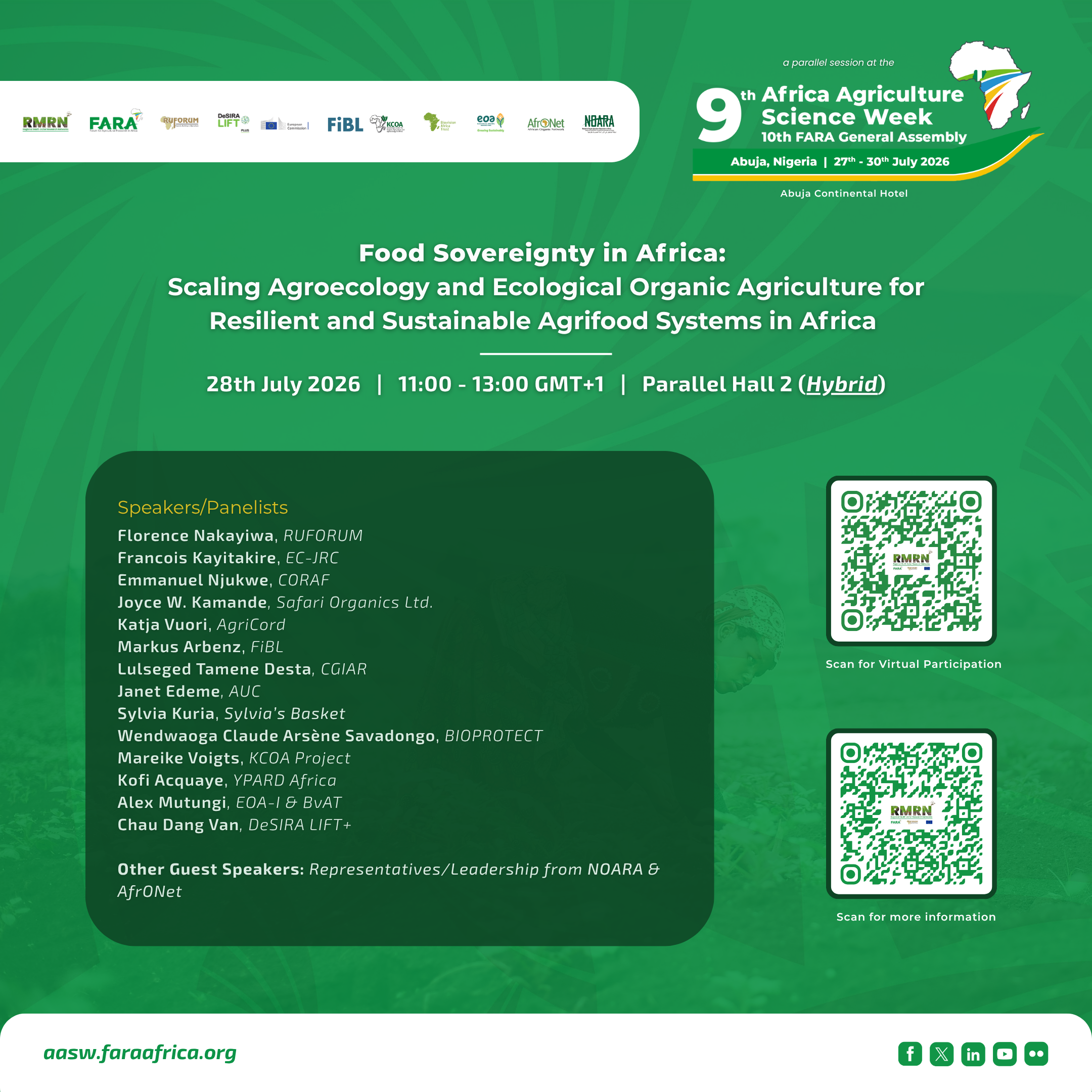
• Food Sovereignty in Africa: Scaling Agroecology and Ecological Organic Agriculture for Resilient and Sustainable Agrifood Systems in Africa

    Abuja Continental Hotel, Abuja, Nigeria (Hybrid) Abuja, Nigeria

    Context and Background Africa’s food systems are under increasing pressure from multiple, interconnected challenges, including climate change, land degradation, biodiversity loss, soil fertility decline, and persistent food and nutrition insecurity. Rising temperatures, erratic rainfall patterns, and extreme weather events are undermining agricultural productivity and farmer livelihoods across the continent. At the same time, unsustainable land-use practices have contributed to declining soil fertility, which threatens the resilience of Africa‘s food systems. There is thus a growing recognition of the need for transformative approaches beyond incremental improvements in productivity to address the root causes of vulnerability and unsustainability. Agroecology has emerged as a transformative pathway that integrates ecological principles, scientific knowledge, and local practices to build resilient, inclusive, and sustainable agricultural systems. The Ecological Organic Agriculture Initiative (EOAI) since 2011, a continental initiative of the African Union, aims at promoting ecological and organic agriculture practices across Africa to enhance smallholder farm productivity and food security. The initiative focuses on integrating ecological practices into national agricultural systems and policies and is supported by the African Union Commission (AUC). Across the continent, agroecology and EOA are gaining momentum through farmer-led innovations, research initiatives, and supportive policy dialogues. However, scaling agroecology and EOA requires stronger […]

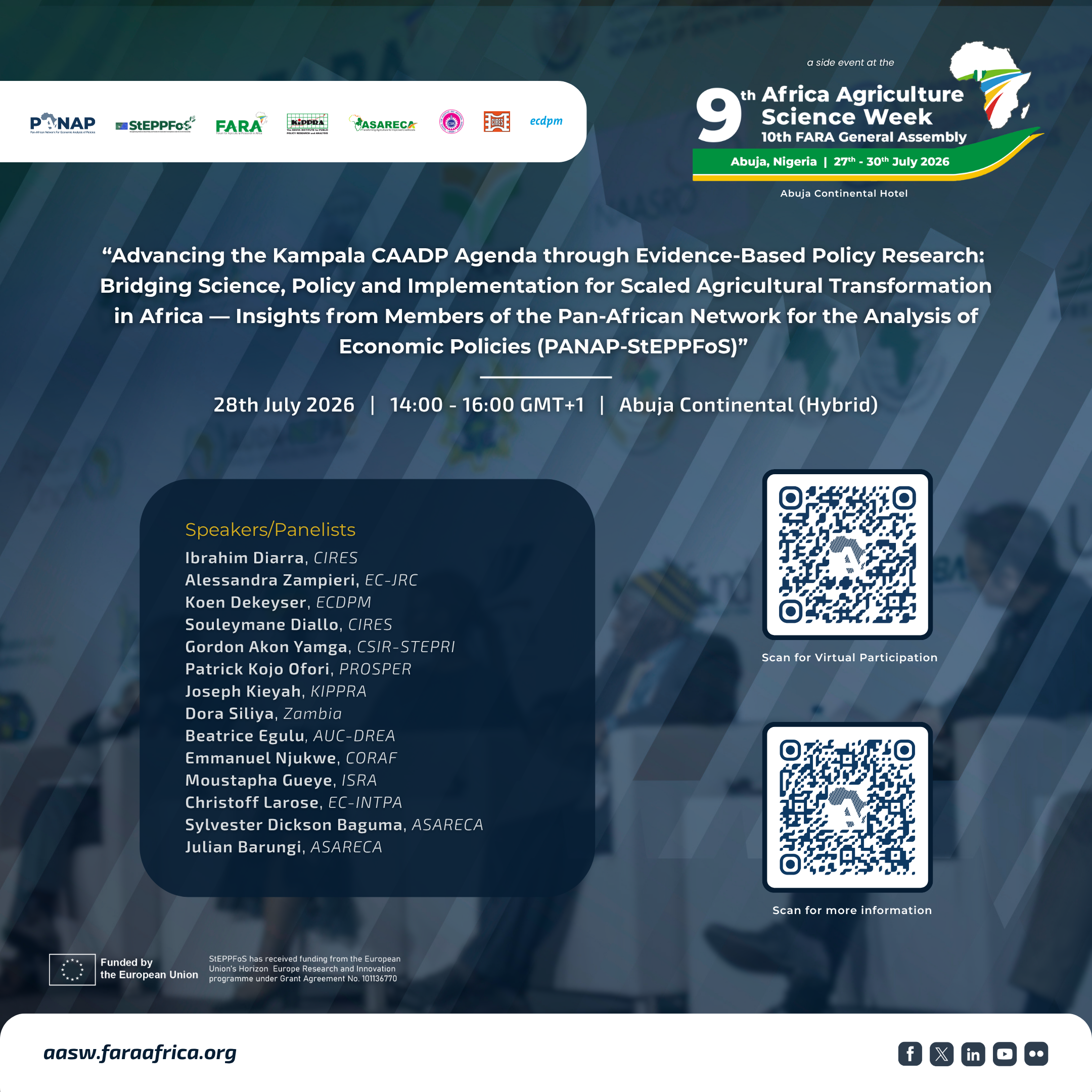
  • Advancing the Kampala CAADP Agenda through Evidence Based Policy Research

    Abuja Continental Hotel, Abuja, Nigeria (Hybrid) Abuja, Nigeria

    Bridging Science, Policy and Implementation for Scaled Agricultural Transformation — Insights from Members of the Pan-African Network for the Analysis of Economic Policies (PANAP-StEPPFoS) Background StEPPFoS, FARA, CSIR-STEPRI, KIPPRA, CIRES, ECDPM, ASARECA The Comprehensive Africa Agriculture Development Programme (CAADP) remains Africa’s flagship framework for driving agricultural transformation, food security, and economic growth. The new phase of the CAADP (Kampala CAADP) discussions and commitments have emphasized the need for strengthened accountability, data-driven decision-making, and comprehensive policy processes to accelerate progress toward the Kampala Declaration targets and beyond. Despite significant progress under CAADP, implementation across many African countries remains constrained by fragmented institutional mandates, weak coordination between research and policy processes, limited use of data and analytics in decision-making and inadequate translation of research into actionable policies. In addition, national and subnational planning processes often operate in silos, limiting the effectiveness of integrated food systems’ transformation. Addressing these gaps requires strengthening the science-policy interface and ensuring that evidence generated by research networks such as PANAP is systematically embedded into policy design, implementation and monitoring frameworks. In this context, the Pan-African Network for Economic Analysis of Policies (PANAP) members, through the StEPPFoS Project have undertaken a range of policy studies which address priority […]