

- This event has passed.
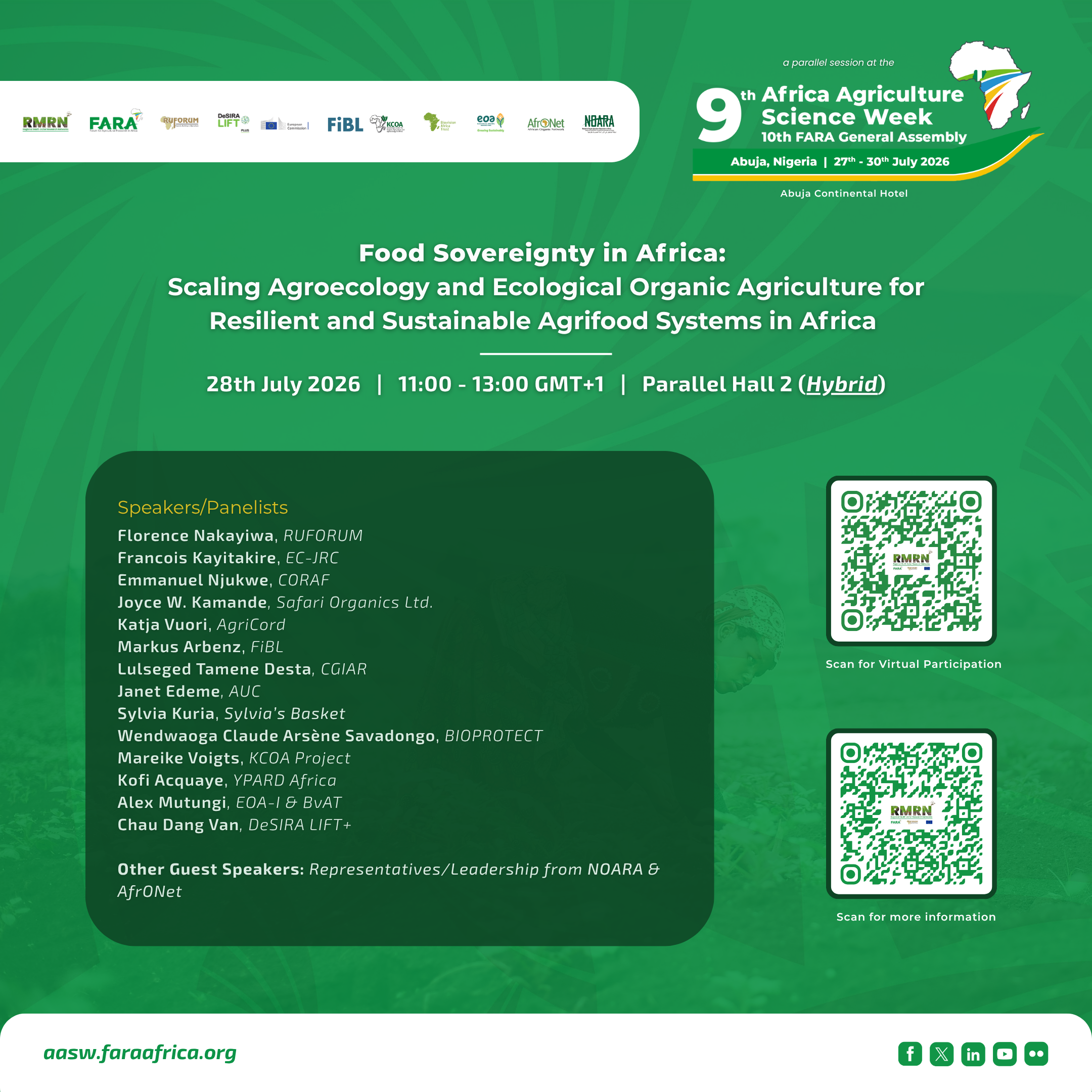
Food Sovereignty in Africa: Scaling Agroecology and Ecological Organic Agriculture for Resilient and Sustainable Agrifood Systems in Africa
Context and Background
Africa’s food systems are under increasing pressure from multiple, interconnected challenges, including
climate change, land degradation, biodiversity loss, soil fertility decline, and persistent food and nutrition
insecurity. Rising temperatures, erratic rainfall patterns, and extreme weather events are undermining
agricultural productivity and farmer livelihoods across the continent. At the same time, unsustainable
land-use practices have contributed to declining soil fertility, which threatens the resilience of Africa‘s food
systems. There is thus a growing recognition of the need for transformative approaches beyond incremental
improvements in productivity to address the root causes of vulnerability and unsustainability. Agroecology
has emerged as a transformative pathway that integrates ecological principles, scientific knowledge, and
local practices to build resilient, inclusive, and sustainable agricultural systems.
The Ecological Organic Agriculture Initiative (EOAI) since 2011, a continental initiative of the African Union,
aims at promoting ecological and organic agriculture practices across Africa to enhance smallholder farm
productivity and food security. The initiative focuses on integrating ecological practices into national
agricultural systems and policies and is supported by the African Union Commission (AUC). Across the
continent, agroecology and EOA are gaining momentum through farmer-led innovations, research initiatives,
and supportive policy dialogues. However, scaling agroecology and EOA requires stronger alignment between
science, policy, and practice, as well as enhanced collaboration among stakeholders.
Across Africa, diverse agroecological innovations are being developed and implemented by farmers,
researchers, and development practitioners. These include integrated soil fertility management, agroforestry
systems, diversified cropping and livestock keeping, community-based seed systems among many. Evidence
from research and practice indicates that such approaches can improve soil and crop productivity, enhance
resilience to climate shocks, reduce dependence on external inputs, and contribute to improved nutrition
outcomes However, despite these promising results, the adoption and scaling of agroecology remain limited.
Key barriers include fragmented knowledge systems, insufficient investment, weak policy support, and limited
coordination among stakeholders.
Addressing these challenges requires stronger partnerships and more effective integration of science, policy,
and practice. Collaborative efforts are needed to generate robust evidence, develop context-site-specific
innovations, and create enabling environments for agroecology to flourish. In this regard, continental and
international organizations and Programmes such as Forum for Agricultural Research in Africa (FARA), Research
Institute of Organic Agriculture (FiBL), European Commission’s Joint Research Centre (JRC), Ecological Organic
Agriculture Initiative (EOAI-Africa), Biovision Africa Trust (BvAT), Network of Organic Agriculture Researchers
in Africa (NOARA), DeSIRA+ Initiative, the Regional Multi actor Research Networks in Africa on Agroecology
(RMRN) and the Knowledge Centre for Organic Agriculture and Agroecology in Africa (KCOA), the EOA-I chaired
by the African Union Commission, and the African Organic Agriculture Network (AfrONet) play a critical role in
advancing research, fostering innovation, and facilitating multi-stakeholder engagement across scales.
The Africa Agricultural Science Week (AASW), under the theme “Innovations and Partnerships for Resilient and
Sustainable Agrifood Systems in Africa”, which is scheduled for 27th – 30th July 2026 in Abuja, Nigeria, offers
a strategic platform to advance the agroecology agenda. The Parallel Session brings together key actors from
research, policy, private sector, and relevant stakeholders to exchange knowledge, showcase innovations,
and forge partnerships. Within this context, a dedicated parallel session on agroecology is both timely and
necessary to highlight its contribution as a science-based, innovation-driven approach to agrifood systems
transformation.
In this regard, the RMRNs—comprising of RMRN-EA in East Africa, RADIUS in West Africa, and RAENS in Southern
Africa, FARA, FiBL and KCOA, the EC-JRC, RUFORUM, the DeSIRALift+ Initiative, NOARA, EOAI and AfrONet
will co-organize a Parallel Session during the Africa Agriculture Science Week 2026. The Parallel Session is
scheduled to take place on 28th July 2026. The proposed Parallel Session aligns with the Conference Theme:
Innovations and Partnerships for Resilient and Sustainable Agrifood Systems in Africa and sub-theme 2:
“Climate Resilient Agrifood Systems: Improving Productivity, Resilience and Sustainability” of the Science
Week. This session aims to bridge existing gaps by fostering dialogue among stakeholders, sharing cutting
edge research and field experiences, and identifying gaps and actionable pathways for scaling agroecological
innovations across the continent. By emphasizing partnerships and co-creation, the session will contribute to
strengthening the science-policy-practice interface and to advancing a shared vision for resilient, inclusive,
and sustainable agrifood systems in Africa