
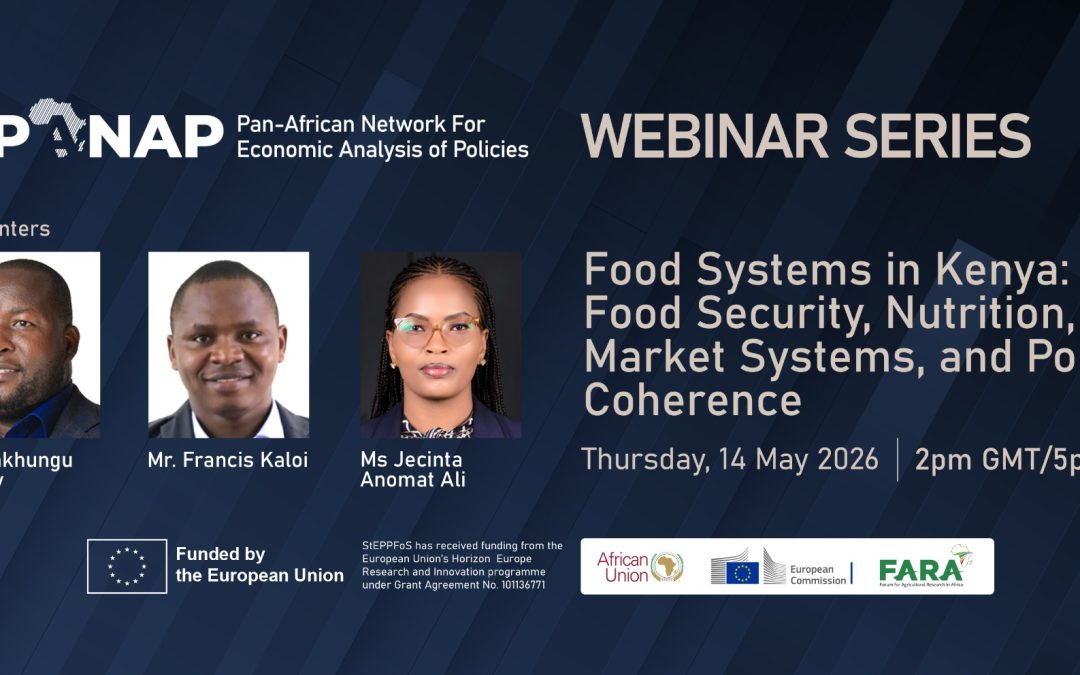
The Pan-African Network for Economic Analysis of Policies (PANAP) is pleased to announce a free public webinar titled “Food Systems in Kenya: Food Security, Nutrition, Market Systems, and Policy Coherence”. The session will bring together policy analysts and researchers from the Kenya Institute for Public Policy Research and Analysis (KIPPRA) to share fresh findings from three complementary studies that explore how Kenya can accelerate food systems transformation in the face of climate stress, urbanisation, and shifting dietary needs.
With food prices, nutrition outcomes, and climate resilience increasingly linked, the webinar will unpack practical evidence on what is working, what is not, and which policy actions can strengthen production, markets, and consumer access to nutritious foods. It is designed for policymakers, researchers, development practitioners, civil society organisations, agribusiness actors, journalists, and students interested in sustainable food systems and inclusive growth.
The Webinar features three presentations. Dr. Wakhungu Hillary, Policy Analyst in KIPPRA’s Productive Sector Division, will present research on Food Systems in Kenya: Adoption, Production, And Consumption of Sorghum and Millet for Enhanced Food Security and Nutrition. The study examines barriers such as seed cost and access, production determinants including cropping systems and market linkages, and the household factors that shape consumption patterns.
In the second presentation, Mr. Francis Kaloi (KIPPRA) will look at Addressing Fruit and Vegetable Wastage Within Informal Food Markets for Sustainable Food Systems in Kenya. The session will highlight key drivers of wastage, such as storage and transport constraints, and review strategies that can reduce spoilage, including improved inventory management, access to credit, vendor training, and investment in shared cold storage infrastructure.
The third presentation will be delivered by Ms. Jecinta Anomat Ali (KIPPRA), focusing on a review of Kenya’s policy, legislative, and institutional framework for food and nutrition security. Her analysis will consider how governance arrangements, coordination, and implementation gaps affect food availability, access, safety, and nutrition outcomes—and what can be strengthened to improve policy coherence across sectors.
Participation is free via Zoom
Date: Thursday 14 May, 2026 at 2PM (GMT) or 5PM (EAT)
Interested participants can register via Zoom using the link below: